STREAM — a catch-up and where it's headed
For the advisors, early testers and prospective customers who took an interest in STREAM · June 2026
What this is. Some of you looked at STREAM a decade or more ago — as a sounding board, an early tester, or a potential customer. A lot has changed since, in STREAM and in the world around it. This is a short, plain-English catch-up: what STREAM set out to do, what we learned, where it’s now pointed, and the choices still open — so we can get your read.
The ask. Tell us whether the new direction resonates with what you see in your world, whether it would be useful to you, and where you’d want to be involved — as a sounding board, an early pilot, or an introduction. Each section links to a fuller document if you want the detail.
1. A reminder of what STREAM set out to do
Section titled “1. A reminder of what STREAM set out to do”The idea was simple, and it still holds. Big engineering and operations projects describe the same equipment across dozens of disconnected sources — drawings, 3D models, spreadsheets, datasheets, databases — each with its own names, units and update cycles. STREAM pulled those together into one trusted view: ask “show me everything we know about pump P-101,” see it all in one place, and immediately spot where sources disagreed or data was missing.
The clever part, then and now, was that it unified records by matching their identifiers, kept disagreements visible instead of quietly guessing a winner, and let different audiences see the same data their own way. If that’s roughly what you remember, you remember the right thing — it still works that way. What’s changed is who we point it at, and how we frame it.
2. What we learned — the lesson worth sharing
Section titled “2. What we learned — the lesson worth sharing”STREAM was first sold as a way to hand project data from the engineering contractor (EPC) to the asset owner. That turned out to be the wrong place to start: the contractor paid for it, yet was the party least served by the transparency it created — they often preferred to keep inconsistencies quiet and hand over late. The owner wanted the clean data but didn’t hold the purse. The right idea, aimed at the wrong customer. (Candidly, STREAM reached some compelling demonstrations and real interest, but never went on to a full production rollout.)
3. The market caught up — so the pitch has to be sharper
Section titled “3. The market caught up — so the pitch has to be sharper”“Bring many sources into one view” was novel in 2012. Today every big platform markets it — AVEVA, Hexagon’s spun-out Octave, Bentley, Cognite. So STREAM can’t win as “another data hub.” What’s still genuinely distinctive is narrower, and we think more valuable: keeping many changing sources continuously reconciled, with every value traceable to its source, disagreements surfaced rather than hidden, and the picture self-correcting as sources change.
In a phrase, it comes down to four C’s: continuity, consistency, completeness — and therefore confidence. Reconcile the sources continuously, make the record consistent and as complete as the job needs, and the owner can finally trust what it knows enough to act on it.
4. Where STREAM is pointed now — and why it should land
Section titled “4. Where STREAM is pointed now — and why it should land”We’re aiming it at the owner directly, where the buyer actually wants clean data, and at a market close to home: Australian regional and mid-sized water utilities and council water businesses — starting in South-East Queensland. The target isn’t shiny new projects; it’s the pipes and plants already in the ground, where nobody is quite sure what they have.
Aging asbestos-cement mains are the sharp example: utilities are now told to manage them by risk, but their records contradict each other — and getting it wrong means service failures and asbestos exposure. Regulators are increasingly demanding utilities “prove they know their assets.” STREAM’s job is to give them that proof, from the messy data they already have.
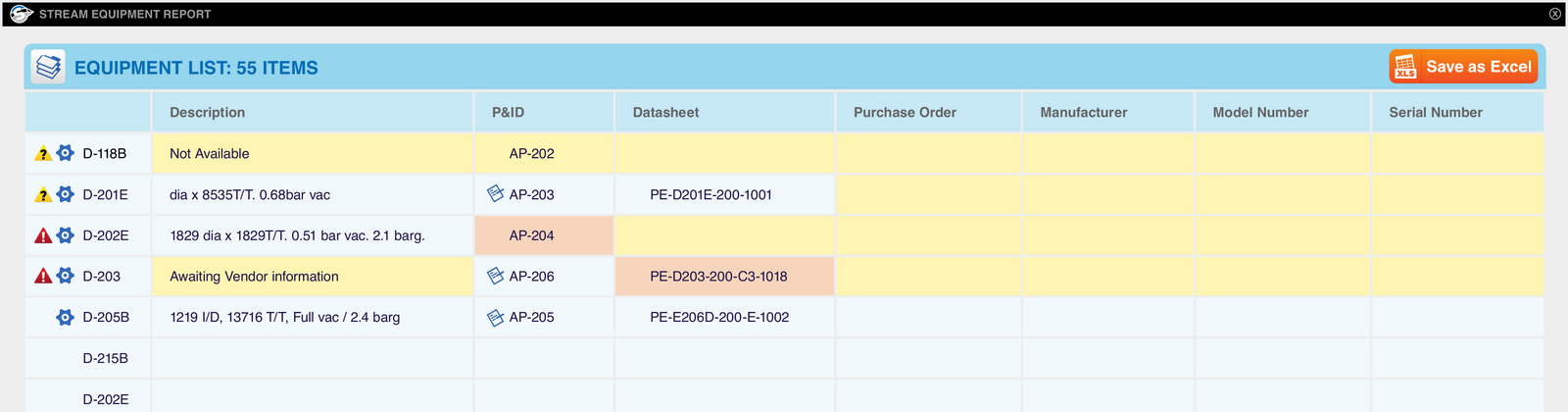
The clearest single picture of the value — per item, what’s present, missing or conflicting across sources:
5. What’s the same, and what’s new
Section titled “5. What’s the same, and what’s new”- The same: the engine you found interesting — reconciling many sources, keeping conflicts and their origins visible, and serving different audiences their own view of one set of data.
- New: the target (water owners, not EPC handover); the framing (data assurance — “prove you know your assets” — not document handover); and a modern technology base (the original was Windows-era; those choices are being reopened).
6. The choices still open — your perspective welcome
Section titled “6. The choices still open — your perspective welcome”We’re working through how to build it. A couple of these matter to you more than the rest:
- Where your data lives. We’re leaning toward keeping data in Australia, in a dedicated (not shared) environment, with on-premises possible for utilities that require it — because data sovereignty matters in this sector. Does that match your expectations?
- How people sign in. We’re leaning toward using the Microsoft (Entra / Microsoft 365) accounts most agencies already have, so access simply works with no new logins. Does that fit your environment?
- One thing we’ve settled: you’ll customise data flows and rules in TypeScript — a standard, widely-used language — rather than a proprietary scripting language, so the skills are common and the tooling familiar. Other engineering choices (like the underlying data store) we’re still weighing — happy to go into the detail with anyone who’s interested.
→ The full reasoning behind each choice is in architecture.md.
7. How an engagement is structured
Section titled “7. How an engagement is structured”So there are no surprises, here’s the shape of working with STREAM:
- It starts with a pilot on your own data — we connect a few of your real sources, reconcile them, and show you your actual gaps and conflicts before any big commitment.
- The setup is a genuine piece of work, charged as an up-front implementation fee — connecting your systems, configuring the views your teams need, and getting your data in.
- That fee is credited against your ongoing subscription, so it’s a head start on your licence rather than an extra charge on top.
- Then an annual subscription keeps the picture live, with further services (new sources, new views) as the deployment grows.
- Easy to buy within your procurement rules — we intend to be available through the pre-qualified panels you already use (such as Local Buy and VendorPanel), so an early engagement can typically proceed by quotation rather than waiting on a full public tender.
We’re still settling the exact figures — the fee, how much of it credits back, and the subscription tiers — and your read on what feels right for a utility of your size would help.
8. Where you could help
Section titled “8. Where you could help”- Tell us if this resonates — does the problem, and the water focus, match what you see?
- Would it be useful to you or your organisation? Would you consider an early pilot, or being a reference?
- Introductions — to the right people at a water utility, or others who’d find this valuable.
- For the technically inclined — your thoughts on the open choices above.
If you’d like the fuller story behind any of this: the journey · the problem · what STREAM does · what it must deliver · how it’s built.